

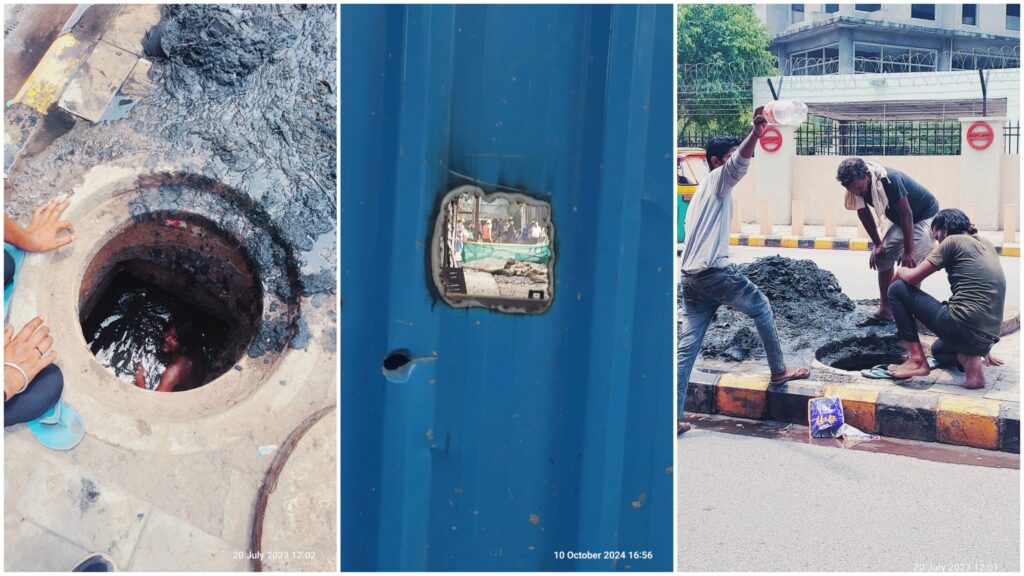
During COVID lockdown, sanitation workers were showered with flowers across the country in gated households when RWAs decided to acknowledge their labour for the well-being of society in the crisis. Yet those same workers were not paid due wages by authorities and the same civil society members did not care whether they were provided with safety equipment like gloves and personal protective equipment considering the contagiousness of the life-threatening virus. This ironic attitude is deeply embedded in the Indian psyche due to the logic of caste that relegates sanitation work as belonging to certain lower castes, relieving rest of the society of any care, responsibility and accountability. Those worst affected by such systemic hypocrisy are workers engaged in manual scavenging including in insanitary latrines, sewers, septic tanks, railways and storm water drains. In urban areas, contractual and informal workers are condemned to face one of the worst forms of structural violence as they are compelled to be perpetually at the front line facing nearly an epidemic of deaths during ‘hazardous cleaning’ of sewers and septic tanks. Though the Prohibition of Employment as Manual Scavengers and their Rehabilitation Act, 2013 (the MS Act, 2013 hereinafter) attempts to eliminate manual scavenging, workers’ experiences with the law expose exclusion, perpetual societal violence, and routine violation of right to dignity. The exclusionary nature in the legal framework and the wilful neglect by the executive lead to a systemic denial of substantive relief for the worker facing such violence at the hands of the state and society.
Legal Loopholes, Tokenism, and the Continued Denial of Dignity
In a civilized society, there is no place for a dehumanizing practice like manual scavenging borne out of a caste-based enslavement. However, the civility of Indian society may be measured by how long it took from judicial cognizance of the practice in early 1920s to when it was statutorily criminalized in 1993. Yet even when it was criminalized through an exclusive legislation focused on manual scavenging in 1993, it was done so with an over emphasis on environment concerns and not the dignity of persons oppressed by the practice. Though at present, the MS Act 2013 recognizes in the statute’s Preamble ‘the historical injustice and indignity’ attached with the practice and acknowledges the ‘iniquitous caste system’ but such symbolic recognition remains a superficial act of tokenism due to dilution of the right to dignity within its’ framework. Substantively, even after expanding the prohibition from dry latrines in 1993 to include ‘hazardous cleaning’ of sewers, septic tanks and railways in 2013, the protections offered are exclusionary and do not safeguard workers affected. The erstwhile definition of manual scavenging in 1993 Act was focussed on dry latrines wherein human excreta was carried with bare hands, brooms, or metal scrapers into baskets. The legislative intent behind the expansion of prohibition in MS Act 2013 is compromised as it dilutes the scope of protection by allowing manual scavenging aided by protective equipment for workers’ safety – the onus of which is on the employer who has hitherto been the offender. The Act specifies that a person using ‘cleaning devices and protective gear as notified by the government’ in Manual Scavenging Rules, 2013 shall not be deemed a manual scavenger. Employers exploit this loophole by providing rudimentary, inadequate gear (like bamboo sticks called khapacchi, gunny bags, metal rods and levers to open the lids) that do nothing to safeguard dignity, safety or health of the worker from toxic life threatening gases, allowing them to bypass accountability and continue manual cleaning while claiming legal compliance. The statute also excludes these workers engaged in hazardous and undignified manual scavenging of sewers and septic tanks from rehabilitative relief. Though the provision introduced in 2013 also mentions ‘cleaning devices’ to protect workers’ dignity, mechanization of sewer and septic tank cleaning was done as late as in 2018 with the introduction of only 200 suction and jetting machines in the Delhi Jal Board.
NAMASTE Policy’s Contradictions: Masked Fatalities, Narrow Definitions, and the Ongoing Systemic Killing of Sanitation Workers
At present, NAMASTE (National Action for Mechanised Sanitation Ecosystem) portrayed as a reformed rehabilitative policy governed by the Ministry of Social Justice and Empowerment replaced the erstwhile ‘Self Employment Schemes for Rehabilitation of Manual Scavengers’. The policy aimed to mechanize sanitation work and to ‘ensure the safety and dignity’ of workers, however, at the same time it ironically identifies the objective as ‘systemizing human entry into sewers and septic tanks through the organization of well-trained, professional, motivated and appropriately equipped’ workers. In a Rajya Sabha reply to an unstarred question 2201, “Death of Sanitation Workers”, the Ministry of Social Justice & Empowerment provided calendar-year data from National Commission for Safai Karamchari on deaths in sewers and septic tanks; the year 2023 saw 63 workers’ deaths and in 2024, the number was 50. This is the official figure and needless to say, many deaths are not even taken cognisance of through an FIR due to under reporting. There is clear evidence that workers are dying even in 2025 — in multiple states, including high-visibility incidents — which shows routine undermining of this claim of ensuring ‘zero fatalities’ under the policy. According to the Safai Karamchari Andolan study, there have been 1,760 fatalities during sewer cleaning, with numbers continually rising, while the Ministry of Social Justice and Empowerment (MSJE) verified the deaths of 161 individuals in sewers and septic tanks throughout the years 2019, 2020, and 2021 across 18 states in India, through a Right to Information response. In an official reply to a Rajya Sabha unstarred question 1580 on March 12, 2025, regarding manual scavenging in the country by the Minister of State for Social Justice and Empowerment, the Ministry stated that there is ‘no report of violation has been received from any state’. This official zero-death figure is by virtue of the narrow framing of the legal definition of manual scavenging limited to insanitary or dry latrines. However, data from similar parliamentary responses acknowledge deaths due to ‘accidents’ during the ‘hazardous cleaning’ of sewer and septic tanks— a classification often cited by critics as masking the persistence of manual scavenging in sewer and septic tanks which is in practice a form of systemic murders due to societal and state’s wilful neglect.
Caste, Birth, and Occupation: Ambedkar’s Insight on Structural Inequality and Denied Mobility
Dr Ambedkar once remarked, “In India, a man is not a scavenger because of his work. He is a scavenger because of his birth— irrespective of the question whether he does scavenging or not.” Due to the graded hierarchy in caste system which Ambedkar defines as an ‘an ascending scale of reverence and a descending scale of contempt’ and the religious notion of ritual purity and pollution combined, the upper castes gatekeep access to education and are in position dominate the upper layers of the bureaucracy, the media, civil society, business, and academia. Those at the very bottom of the caste hierarchy are to be found in ‘dirty’ occupations and are not allowed many opportunities for occupational mobility.
He articulated that Gandhism presents a paradox when it advocates for liberation from foreign oppression, necessitating the dismantling of its existing political structure while simultaneously, it aims to preserve a social structure of caste that allows for hereditary and perpetual dominance of one class over another. He presents two characteristics of Gandhism – one is it facilitates ‘those who have to keep what they have’ while obstructing those who lack them from acquiring what they are entitled to. On Gandhian perspective on strikes, his adulation for caste, and his notion of trusteeship by the affluent for the welfare of the impoverished culminates in the essence of Gandhism. The second distinctive aspect of Gandhism is to deceive individuals into perceiving their unfortunate circumstances as the most good fortunes. Ambedkar argues that Gandhi’s approach to manual scavenging is fundamentally flawed because it romanticises an occupation built on caste oppression. Gandhi highlights instances such as a young Brahmin volunteering to clean latrines in his ashram to teach cleanliness as ‘if he wanted the Ashram sweeper to do his work well, he must do it himself and set an example’. For Ambedkar, this is ‘false propaganda’—a symbolic gesture that does nothing to dismantle the caste structure that assigns this dehumanizing work to Dalits by birth. He insists that a Brahmin doing scavenging temporarily is never equivalent to someone born into the caste condemned to do it for life; the Brahmin sheds the task without shedding caste privilege, while the Dalit cannot shed the stigma even if he stops doing the work. For Ambedkar, the fundamental difference is this: Gandhi moralises and spiritualises caste occupations; Ambedkar exposes and rejects them as instruments of structural violence. Gandhi’s framework reassures caste Hindus while urging the oppressed to accept degradation as duty, whereas Ambedkar insists that no amount of moral dressing can legitimise an occupation imposed by birth-based hierarchy. True reform, for Ambedkar, lies not in glorifying caste-prescribed work but in abolishing the caste system that makes certain groups ‘scavengers’ irrespective of their actual labour. Thus, Ambedkar sees Gandhi’s approach as not merely inadequate but actively harmful—an “outrage and cruel joke” on those trapped in oppressive caste roles.
Gandhi’s Endorsement of Hereditary Occupation: Moral Duty, Denial of Rights, and the Legacy Shaping Modern Sanitation Policy
On the other hand, in Gandhi’s understanding, the central belief in Hinduism was the conviction that individuals must follow their ancestor’s occupational traditions. Gandhi, in his 1936 essay ‘The Ideal Bhangi’ accepted the socio-structural premise of a hereditary linkage between caste and occupation. Instead of calling out the oppression and indignity in the practice, he justifies it by comparing the Bhangi’s role to that of a ‘mother ensures health of an infant by cleaning off the dirt’, arguing that the sanitation worker similarly protects and safeguards the health of the entire community through the maintenance of public sanitation. While Gandhi advocated for the valuing the ‘Bhangi’s (scavenger’s) labour’ and asserted the universal capability of all individuals to perform sanitation duties, his position did not include a frontal challenge to the caste based hereditary association between the Bhangi caste and the occupation of scavenging but rather reinforced it.In Gandhi’s reasoning, the fundamental rights of sanitation workers, specifically their right to strike, were deemed subordinate to the imperative of public health and the ‘greater good’ of society. In response to the widespread and militant strikes initiated by sweepers across several major Indian cities (including Bombay, Srinagar, Multan, Delhi, and Lahore) around 1946—a period marked by expectations for improved conditions—Gandhi formally articulated his objection to such exercise demanding fundamental rights for sanitation labour. He contended that there were specific domains where strikes were ethically unwarranted, explicitly categorizing public sanitation services under this restriction as ‘wrong’. Gandhi justified this injunction by emphasizing the potential catastrophic consequences of ceasing sanitation work: the accumulation of refuse would lead to the proliferation of disease, thereby jeopardizing communal health. Consequently, he argued that sweepers were morally and socially obligated to maintain their duties for public health reasons. The Swachh Bharat Mission launched by the Modi government in 2014 on Gandhi’s birth anniversary also ails from this Gandhian approach to the problem of manual scavenging.
Moral Valourization as Justification: Modi’s ‘Spiritual Duty’ Narrative and the Normalization of Caste-Based Manual Scavenging
Even the Prime Minister’s political philosophy is characterized by similar strategy of moral valourization and symbolic recognition, which only serves to normalize and perpetuate a caste-based occupation rather than ensure its annihilation through structural reform and mechanization. This is demonstrably evident in both his early writings and later public rituals. In his 2007 book, Karmayogi (meaning one who performs action without attachment to results), Modi, then Chief Minister of Gujarat, articulated a controversial viewpoint on the practice of manual scavenging, primarily performed by the Valmiki community. He asserted that manual scavenging was not merely a livelihood but a ‘spiritual experience’ for the community members and suggested that they would not have continued the work across generations solely for sustenance, but must have found an ‘enlightenment’ that it was their sacred duty (dharma) to work for the happiness and health of society and the Gods. Academic analysis views this statement as a profound example of normalization and the invisibilization of injustice. By attributing the persistence of manual scavenging to a ‘spiritual calling’ rather than to systemic caste-based coercion, economic bondage, and social exclusion, this rhetoric justifies the hereditary nature of the degrading labour, effectively opposing even the prohibition mandated by laws such as the Employment of Manual Scavengers and Construction of Dry Latrines (Prohibition) Act, 1993, and the Prohibition of Employment as Manual Scavengers and their Rehabilitation Act, 2013.
In 2019, at the Kumbh Mela in Prayagraj, Prime Minister Modi performed the ritualistic washing of the feet (Charan Vandana) of sanitation workers, in a nationally televised event. Dalit activists, such as Bezwada Wilson, founder of the Safai Karamchari Andolan, sharply criticized the event as ‘pure optics and a gimmick’. They argued that such paternalistic rituals merely glorify an inhuman occupation and deflect attention from the government’s consistent failure to enforce the PEMSR Act, provide adequate rehabilitation, and mechanize sewer cleaning, which continues to result in numerous preventable deaths from asphyxiation. The central demand of the workers is freedom from the practice, not its ceremonial glorification.
Performative Respect, Persistent Exploitation: How Political Spectacle Undermines Constitutional Dignity and Perpetuates Caste-Bound Sanitation Labour
When through both the ideological assertion and the political spectacle, the elected representatives reinforce Gandhian strategy of valourising of sanitation workers’ labour while simultaneously allowing their perpetual exploitation, undignified treatment and often contempt while performing such labour, the Constitution’s radical resolve to ensure right to life with dignity, right against discrimination and right to dignified livelihood are undermined directly and routinely. It emboldens and propagates the casteist idea that sanitation is to be solely relegated to some castes and is their inherent moral responsibility as prescribed by caste ascriptions as the organizing principle of society, while the upper castes, except indulging in performative acts of sweeping streets on Gandhi Jayanti on occasion of Swachh Bharat Mission, are merely to enjoy the benefits of their service having no accountability and responsibility at all towards their fellow constitutional citizens.
Aishwarya Karan is a PhD candidate at the Faculty of Law, University of Delhi.