

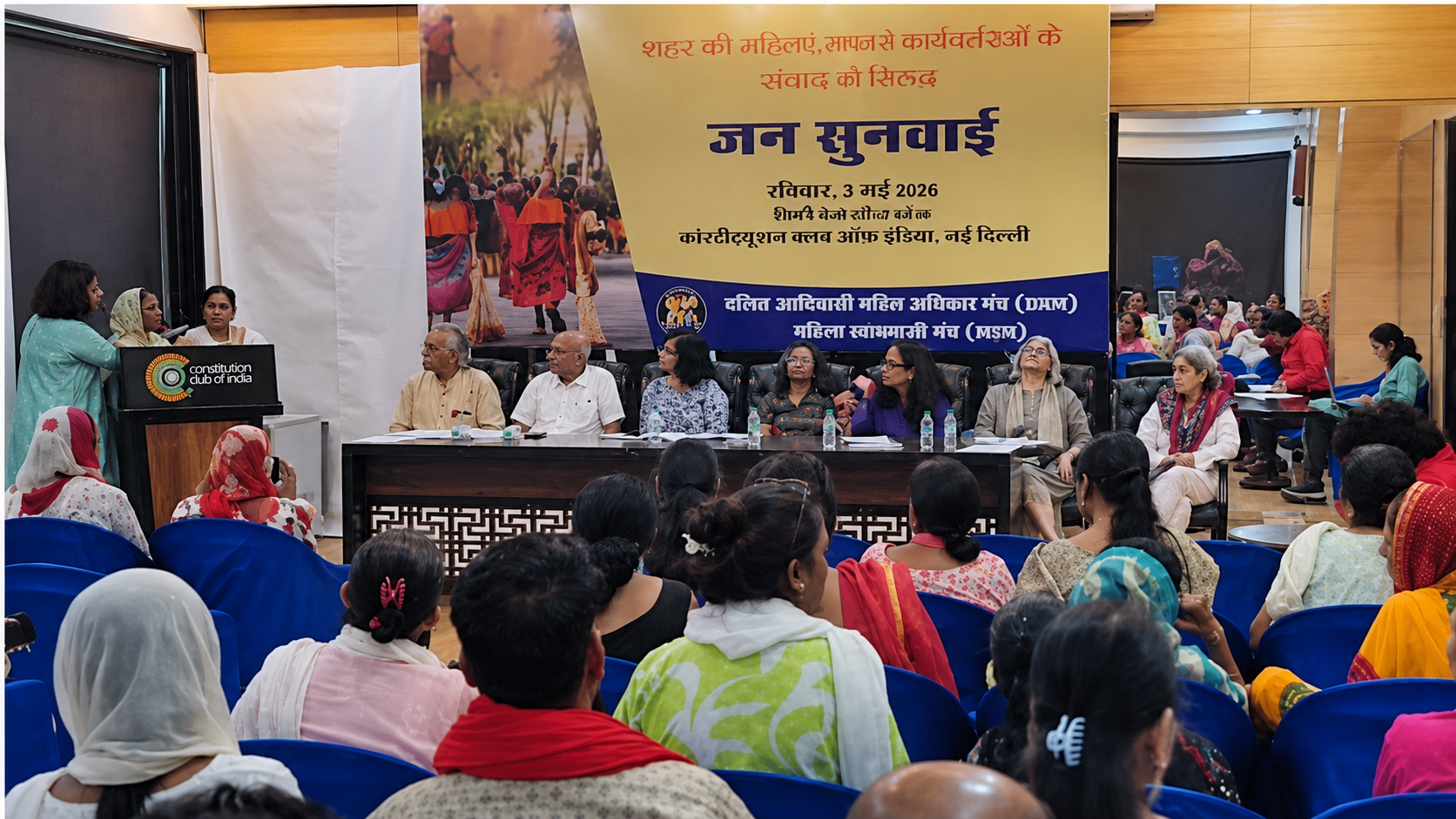
A critical moment in the history of grassroots mobilization among Dalit women workers in the capital, a public hearing held in Delhi on Sunday brought into sharp focus the human cost of outsourcing, contractualization, and the architecture of institutionalized extortion in the city’s sanitation sector, centering the experiences of marginalized and Dalit women workers who bear the heaviest burden of these private informal arrangements. Organised by the Dalit Adivasi Shakti Adhikar Manch (DASAM) along with its women’s wing, Mahila Kaamkaji Manch (MKM), the event was titled ‘Labour Without Security, Lives Without Dignity: Confronting Structural Exploitation and Reclaiming Entitlements’.
Rooted in B. R. Ambedkar’s assertion that he measures the progress of a community by the degree of progress which women have achieved, the hearing was joined by social activists and Dalit women leaders, facilitators, grassroots practitioners, academicians and legal experts. The event opened with the introduction of an expert jury panel of leading voices in law, human rights, gender justice, and labour rights. The jury heard the testimonies, carefully documented and connected to broader legal and policy frameworks and came up with recommendations followed by a brainstorming session moderated by PhD researchers. The panel included:
- Manjula Pradeep, human rights defender and National Convenor, National Campaign on Dalit Women’s Leadership (NCWL)
- Colin Gonsalves, Senior Advocate, Supreme Court of India, and Founder, Human Rights Law Network
- Prof. Sophy K. J., Associate Professor, National Law University Delhi, and Director, Centre for Labour Law Research and Advocacy
- Vrinda Grover, Senior Advocate, Supreme Court of India, and Commissioner, UN Independent International Commission of Inquiry on Ukraine
- Purnima Gupta, feminist educator and founding member of Sahjani Shiksha Kendra and Nazariya Foundation
- Prof. Reetika Khera, Department of Economics, IIT Delhi
- Indu Prakash Singh, social activist, author, and educator working on rights of homeless in Delhi
Building Trust, Breaking Silence: The Road to the Public Hearing from Weekly Dialogues to Public Testimony
The hearing grew out of DASAM and MKM’s sustained initiative, the “Sunday Campaign with Women Workers,” which has facilitated weekly interactions with Dalit women sanitation workers across Delhi’s slum clusters. What began as informal conversations gradually evolved into structured spaces of trust, enabling women to articulate their lived realities and collectively recognise systemic patterns of injustice. Recurring concerns including delayed wages, arbitrary dismissals, unsafe working conditions, harassment, and the absence of formal recognition led to the conception of the public hearing as a platform for accountability.
Testimonies the System Would Rather Silence
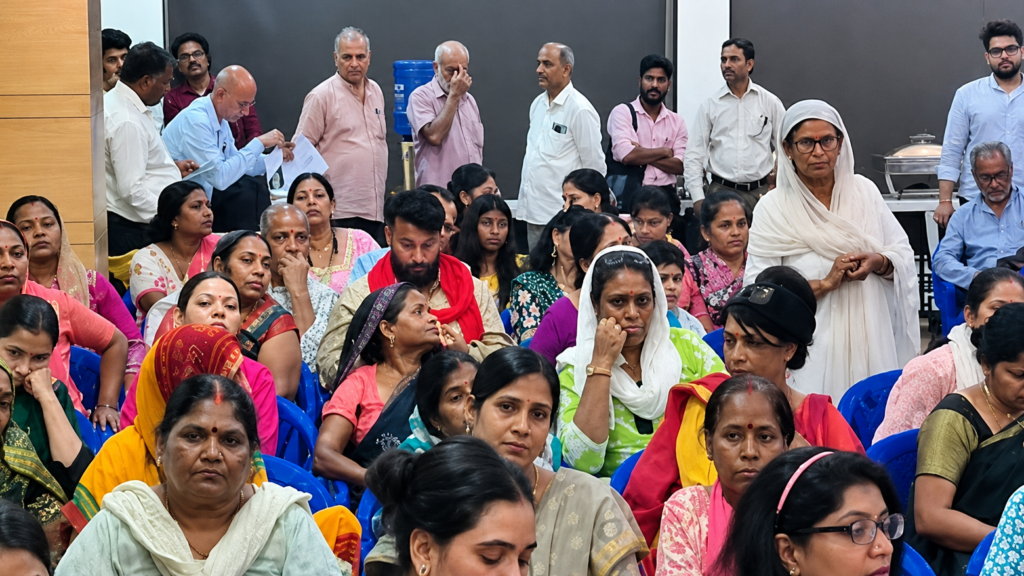
More than 100 Dalit women workers, majority from the Valmiki community proactively took part in public the hearing. They are engaged across sectors as sanitation workers and housekeeping staff in community toilets, as domestic workers and daily wagers in institutions including hospitals, private schools, malls, Municipal Corporation of Delhi (MCD), the New Delhi Municipal Council (NDMC), the Delhi Development Authority (DDA), and the Delhi Metro Rail Corporation (DMRC). Their testimonies revealed deeply exploitative and personal experience under the neo-liberal regime of urban sanitation governance that is both built upon caste hierarchy and routine reproduction. In order to protect their identities, the names and details of women workers have been anonymized.
Testimony of Unnati: ATM cards withheld by contractors, bribes to secure contractual work in NDMC
Unnati studied until the fifth standard. She lives in the slum clusters of Bapu Dham and Sanjay Dham in Delhi and has spent years working as a sanitation worker under the New Delhi Municipal Corporation (NDMC). The nature of the work itself is relentless and physically demanding with working hours running up to 12 hours. Unnati’s responsibilities include desilting drains, cleaning sewers, housekeeping duties, and maintaining sanitation at metro station toilets.
She was defrauded by someone in the hope of permanency. Her entry into what should have been a secure government job began with a demand for Rs 25,000 as a bribe. Unable to pay from her own resources, she took a loan to arrange the amount, believing that regularisation would bring stability and a legitimate income. What it brought instead was a deeper entanglement with the same system of exploitation she had hoped to escape.
The financial exploitation does not stop there. Some workers had their ATM cards taken by contractors. The cards are held until salaries are credited and money is withdrawn before the worker can access it. The wage, already meagre, arrives already depleted. Despite the existence of written contracts, their protective value is effectively zero. Paid leave exists on paper and is routinely denied in practice. There are no holidays. Workers are expected to report regardless of illness. The contract, rather than being a document of rights, functions as a record of obligation with none of the corresponding protections. The workday nominally runs to eight hours but regularly extends to twelve. There is no fixed time at which she can leave. Whether she is released depends on the discretion of contractors.
What her testimony makes visible is the layered architecture of control that governs the lives of NDMC sanitation workers. Entry into employment requires a bribe. Continuation requires ongoing payments. Wages are intercepted before they are received. Leave is denied. Working hours are unlimited. The written contract provides legal cover for the institution while offering the worker almost no enforceable protection. At every point where the law or the employment relationship might have offered Unnati security, a parallel informal system has moved in to extract value from her vulnerability instead. She came to work to build a life but instead the system ensures that the true cost of public sanitation is borne solely by the worker.
Testimony of Anita : Housekeeping Worker in a private school in Hauz Khas told ‘bag uthao, nikal jao’ for speaking against injustice
She worked for five years at a prominent private school in Hauz Khas, where her husband has worked for four years in direct employment. When she took four days of leave following a family bereavement, she was dismissed from work and fined Rs 500 per day of absence. The work at the school routinely exceeded any reasonable job description, with some workers facing physical abuse and they often faced caste-based slurs. Anita spoke of extremely labourious and exploitative working conditions for women including low wages, no leave entitlements, and being assigned multiple roles far beyond her original job description. Workers were asked to carry heavy furniture up four floors of staircases without lift access, housekeeping in school washrooms, classrooms, and school buses, even cleaning the principal’s private residence, and reporting on Sundays. These tasks were frequently performed under the threat of physical abuse and the routine use of caste-based slurs. ESI and PF deductions were made regularly from wages. No benefits were ever received. When she sought accountability, she found none as the school, and the contractor Arjun Enterprises deflected responsibility toward the other. In an incidence of fight between school children in bus, even the police held accountable a house keeping worker and dismissed them from service. Anita joined as a housekeeping worker one week ago as a nanny caring for two children.
Testimony of Muskaan : Story of how privatization of public services strips workers of basic human rights
The testimony of Muskaan, a resident of Kusumpur Pahadi, provides a harrowing look at the systemic failures plaguing women in outsourced labour. Formerly a sanitation worker at an Education Office, her narrative reveals how the privatization of public services strips workers of basic human rights.
Her termination followed a severe medical crisis. Despite falling ill on duty and requiring hospitalization, the absence of medical leave provisions led to her immediate retrenchment. This ‘casualization’ of labour ensures that sickness is treated as a breach of contract rather than a human necessity. Furthermore, her employment was marked by extreme wage insecurity, receiving only one month’s salary over a four-month period.
The barrier to re-entry into the workforce is equally insurmountable. She reports a pervasive ‘bribery gatekeeping’ system, where agencies like Orient (Head Office in Okhla) and Sainath Sales and Services (Head Office in Gurgaon) or their intermediaries demand between ₹15,000 and ₹30,000 for placement.
Beyond the workplace, Muskaan’s life is shadowed by a localized narcotics crisis in Kusumpur Pahadi, Vasant Vihar. She describes a community where systemic neglect and police complicity have allowed drug rackets to thrive, leading to school dropouts and suicides among the youth. Her story underscores that for the outsourced worker, the struggle is not merely against economic exploitation, but against a total collapse of social and institutional protection.
Testimony of Sita: The Gendered Barriers to Compassionate Appointment
The case of Sita, a mother of three sons, illuminates the rigid patriarchal structures embedded within administrative policies. Her father-in-law was a permanent employee of the Municipal Corporation of Delhi (MCD). Following the deaths of both her husband and her father-in law, she sought a compassionate appointment to sustain her family.
Despite her desperate circumstances, she has been systematically denied a permanent position. The administration has invoked a restrictive clause stating that a daughter in law, or putra vadhu, is not eligible for compassionate grounds, telling her directly that she has no right to the claim. This legal interpretation treats the daughter in law as an outsider to the family unit, effectively erasing her role as a primary survivor and caregiver.
Sita was granted only a brief three-month work as a daily wager, a temporary measure that offers no long-term security. Although she has navigated the hierarchy to the level of the Commissioner and submitted written applications, as she was told, she remains trapped in a cycle of administrative silence. Her struggle highlights a critical gap in labour law where gendered definitions of ‘dependency’ are used to exclude women from stable income and employment.
Testimony of Chandrakanta: Wage Theft and the Weaponization of Authority
The testimony of Chandrakanta, exposes the extreme vulnerability of domestic staff when employed by individuals with proximity to state power. While working at a girls’ hostel owned by a retired police official, she faced a calculated pattern of wage theft and intimidation. After two months of labour, she was paid a mere ₹2,000 against a promised ₹20,000 and summarily dismissed.
When she demanded her rightful earnings, her employer utilized harassment, recording videos to falsely frame her demands as extortion. Further administrative violence followed in the form of criminal allegations, including accusations of theft, designed to silence her. Fearing for the safety of her remaining son following the tragic suicide of her other son and the death of her husband, she was forced to abandon her claim. Her narrative illustrates how the threat of police power and social stigma are weaponized to ensure the total submissiveness of the Dalit workforce.
Testimony of Deepa: Hidden Labour and the Erosion of Rights
Deepa’s testimony reveals the deceptive nature of job designations in institutional settings. Employed as an aaya (caregiver) at an educational institution with a monthly salary of ₹14,000, she found the reality of her role far exceeded her formal title. In addition to caregiving, she was compelled to perform the hazardous and stigmatized labour of cleaning washrooms, a task often offloaded onto women workers without additional compensation or specialized equipment.
Furthermore, Deepa’s employment is characterized by a complete lack of labour protections. Despite the physical and mental toll of her multifaceted role, she is denied any form of leave. This absolute lack of respite, combined with the expansion of her job description into sanitation work, underscores how institutions replicate exploitative labour practices by bypassing standard worker entitlements.
Testimony of Sarita: The Cycle of Subsistence Wages
The experience of Sarita reflects the precarious nature of the informal urban economy where wages fail to meet the rising cost of living. While employed at a private jewellery establishment in Sarojini Nagar, Sarita earned a monthly salary of ₹10,000. As an individual living alone in rented accommodation, she found this amount insufficient to cover basic subsistence expenses. Despite formal requests for a salary increment, her employer remained indifferent to her economic distress.
Sarita’s trajectory highlights the reliance on informal social networks for survival. After resigning from the shop, she secured a position at a petrol pump through a friend’s recommendation, where her salary increased slightly to ₹12,000. Her story demonstrates how workers are forced into lateral movements between low skill sectors, gaining marginal wage increases that still leave them on the edge of financial instability.
The Human Face of Outsourcing
The hearing made unmistakably clear that behind every outsourcing arrangement and every subcontracted sanitation tender lies a human being whose dignity, security, and legal rights are systematically subordinated to institutional convenience. Outsourcing and contractualization dominate the labour framework governing Delhi’s sanitation sector, allowing institutions to evade responsibility for the workers they effectively employ. Workers are hired through contractors under short-term agreements that are arbitrarily renewed, sometimes requiring the payment of bribes for continued engagement.
Madhu Rani’s testimony illuminated with particular precision how this system operates in practice. Wages are paid in cash or manipulated through bank transfers specifically to remove documentary proof of payment, making it impossible for workers to establish what they were owed, what was deducted, or by whom. Accountability dissolves across a chain of contractors and subcontractors, leaving workers unable to identify which organisation is responsible for their conditions or their wages.
Workers reported monthly earnings ranging between Rs 8,000 and Rs 16,000, with frequent wage delays and arbitrary deductions. Unsafe working environments, the absence of protective equipment, and minimal access to healthcare compound their vulnerability in ways that extend well beyond the workplace.
Testimony of Reeta: The Gendered Barriers to Compassionate Grounds Appointment
The case of Reeta, a resident of Shamli and mother of three sons, illuminates the rigid patriarchal structures embedded within administrative policies. Her father-in-law was a permanent employee of the Municipal Corporation of Delhi (MCD). Following the deaths of both her husband and her father-in-law, Reeta sought a compassionate appointment to sustain her family. Despite her desperate circumstances, she has been systematically denied a permanent position. The administration has invoked a restrictive clause stating that a daughter in law, or putra vadhu, is not eligible for compassionate grounds telling her directly that she has no right to the claim. This legal interpretation treats the daughter in law as an outsider to the family unit, effectively erasing her role as a primary caregiver and survivor. Reeta was granted only a brief three-month stint as a daily wager, a temporary measure that offers no long-term security. Although she has navigated the hierarchy to the level of the Commissioner and submitted written applications, she remains trapped in a cycle of administrative silence. Her struggle highlights a critical gap in labour law where gendered definitions of “dependency” are used to exclude women from stable, dignified employment.
The Intersection of Caste, Gender, and Political Exclusion
The testimonies illuminated how caste continues to dictate occupational roles, with sanitation work disproportionately assigned to Dalit communities, thereby reinforcing stigma and entrenching discrimination across generations. Gender compounds this vulnerability considerably. Women carry the double burden of paid labour and unpaid domestic responsibilities while simultaneously navigating harassment and wage manipulation in their workplaces.
The women workers from Kusumpur Pahadi also spoke how the men and youth of the community are being pushed into alcoholism and drugs in complicity with the law enforcement that allows the drug racketeering to operate and indulge in corruption and profiteering from it. Many young boys are forced to leave school due to such addiction, amidst rising instances of violence and lack of mental health counselling. Some even succumbed to suicide. This is not an individual’s problem but a systemic issue due to extremely exploitative contractual and informal private work arrangement for parents, weaking learning capacities for youth amidst deepening crisis of unemployment and lack of amenities at school. Despite political representation through reserved constituencies, Dalit women sanitation workers remain largely excluded from decision-making spaces. The absence of meaningful unionisation further weakens their ability to negotiate or resist exploitation collectively.
Key Recommendations: Toward Sustained Collective Mobilisation and judicial accountability
The public hearing functioned as considerably more than a forum for testimony. They may not be judicial proceedings but are a precursor to informed legal action . It became a space for collective accountability. By bringing together workers, legal experts, researchers, and civil society actors, the event transformed individual experiences into collective evidence, opening pathways for legal and policy intervention. They may not carry any binding authority and issue no enforceable orders but their power lies in their capacity to make visible what institutional systems are designed to keep hidden.
The testimonies placed before the jury panel documented a labour system in which contractualization serves a precise caste led economic function: it allows institutions to consume the labour of Dalit women sanitation workers while dispersing responsibility for their conditions so widely that no single actor can be held accountable. The bribe paid to secure a job, the salary intercepted before it reaches the worker’s hand, the job description that expands without limit: these are not failures of individual employers features of a political economy that has consistently priced Dalit persons’ labour below the cost of their dignity. It is among the first such hearings in Delhi to centre the structural realities of Dalit women sanitation workers within outsourced labour systems, and its significance lies as much in what it initiated as in what it documented.
The jury panel, having heard the testimonies proposed the following recommendations. They are offered not as abstract policy suggestions but as direct responses to what was heard in that room.
1. Health and Medical Camps: Organise regular health camps in collabouration with government hospitals, specifically designed for sanitation workers whose bodies bear the cumulative cost of decades of hazardous labour. Chronic respiratory illness, damaged eyesight, skin conditions, and occupational cancers must be diagnosed early and treated consistently. Workers without ESI coverage must not be left to fund their own medical care through private tests and borrowed money.
2. Capacity and Leadership Building: Conduct community-based leadership programmes targeting women and youth from Valmiki communities, with a specific focus on labour rights education and collective consciousness. Workers who do not know they have rights cannot assert them. Those who know but have no collective structure behind them cannot sustain that assertion.
3. Research and Documentation for Legal Action: Systematically collect and document violations of labour law, including wage theft, denial of ESI and PF benefits, illegal bribe demands, and unsafe working conditions. This documentation must be built with legal intervention in mind, structured to support petitions, complaints before labour courts, and public interest litigation.
4. Social Media Advocacy: Launch targeted social media campaigns that move beyond workplace conditions to capture the full reality of these workers’ lives, including housing insecurity, lack of clean water, and inadequate sanitation in the very slum clusters from which sanitation workers are drawn. Video testimonies, recorded with informed consent and options for anonymity, can bring institutional accountability into public view in ways that written documentation alone cannot.
5. Building a Solidarity Network: Develop a sustained network of lawyers, journalists, researchers, and activists committed specifically to sanitation workers’ rights. Legal aid must be accessible at the moment it is needed, not months later. Media relationships must be cultivated before a crisis and no worker should have to face a contractor alone.
6. Accessible Rights Education: Produce simple, accessible audio-visual materials in Hindi explaining workers’ entitlements under relevant labour laws, including wage rights, health cards, ESI, Provident Fund (PF), occupational safety standards, and the right to protective equipment. The existing law must be made available for workers see and share amongst themselves.
7. Existing Unions’ support Mobilisation: Strengthen engagement with existing trade unions and labour organisations to build collective bargaining capacity. The absence of union representation for contractual sanitation workers, as testimony after testimony confirmed, is not incidental to their exploitation. It is a precondition for it.
8. Digital Wage Tracking: Establish systems to document wage payments digitally, creating a verifiable record that exposes patterns of salary deduction, delayed payment, and wage theft. What cannot be documented cannot easily be challenged in a labour court.
9. Differentiated Strategies for Different Worker Categories: Recognise that contractual, permanent, and informal sanitation workers face distinct legal vulnerabilities and require tailored advocacy strategies. A worker hired directly by a municipal body occupies a fundamentally different legal position from one supplied through a private contractor. The strategies used to secure their rights must reflect that difference.
10. Political Economy of Contractual Labour: Commission research into the relationships between workers, contractors, and state agencies within privatised sanitation governance. Understanding who profits from this system, and how, is a prerequisite for dismantling it. The political economy of contractualization must be named before it can be effectively challenged.
11. Documentation of Break in Service Practices: Record and challenge instances where artificial breaks in employment are used to deny workers regularisation and accumulated benefits. Collect employment records, contractor communications, and worker testimonies to build cases against this practice, which disproportionately affects those who have given years of unacknowledged service to public institutions.
12. Challenging Contractor Exploitation: Investigate and publicly expose exploitative contractor practices including wage theft, bribery for employment, and systematic denial of legal entitlements. Verify contractor licensing and regulatory compliance. Advocate for stronger state oversight of private contractors operating within public sanitation systems. Unchecked privatisation without accountability is not governance. It is organised abandonment.
13. Addressing Sexual Harassment: Ensure that women sanitation workers are aware of and able to access grievance mechanisms under the Protection of Women from Sexual Harassment Act (POSH Act, 2013). Explore the role of Local Committees in supporting unorganised women workers who fall outside the institutional structures that the Act was primarily designed to serve. No woman should have to choose between her safety and her salary.
Organisers emphasised that the hearing is not an isolated event but part of an ongoing mission to build collective leadership among marginalised sanitation workers. DASAM and MKM reiterated their commitment to ensuring that these voices translate into concrete and lasting action. What the testimonies made abundantly clear is something that policy documents and municipal reports consistently obscure: Dalit women sanitation workers are not a labour category. They are human beings whose indispensable contribution to urban life is met, day after day, with invisibility, insecurity, and injustice. Madhu Rani’s words stay with us as a reminder of what is at stake. She was told to run as far as she could. Instead, she came to this hearing and spoke. That act of speaking, repeated by hundreds of women across the day, is where this movement begins.